
Islamic Inspiration and Somali Sculpture at Wadaag Commons
Starting in the fall of 2025, CAFAC bustled with activity all centered on the Wadaag Commons project: a series of public artworks created for an affordable housing development in Minneapolis’s Seward neighborhood managed by Redesign Inc., the Office of Cultural Work (OCW) and Noor Companies. The project sought to marry affordable housing with beautiful, culturally-relevant art created by East African and SWANA artists in and around the building. CAFAC had the honor of working with three talented artists - Hend Al-Mansour, Hibaaq Ibrahim, and Yasmin Yassin - to help design and fabricate several outdoor sculptures at Wadaag Commons.
HEND AL-MANSOUR
Perhaps the most prominent piece of artwork created for this project is an enameled mural that stretches 40 feet up the height of the building. This piece, designed by Hend Al-Mansour and fabricated at CAFAC, catches the eyes of commuters along nearby Franklin and Cedar Avenues and welcomes the building’s residents, both figuratively and literally, with prominent henna artwork and Arabic calligraphy featuring the word “welcome.”
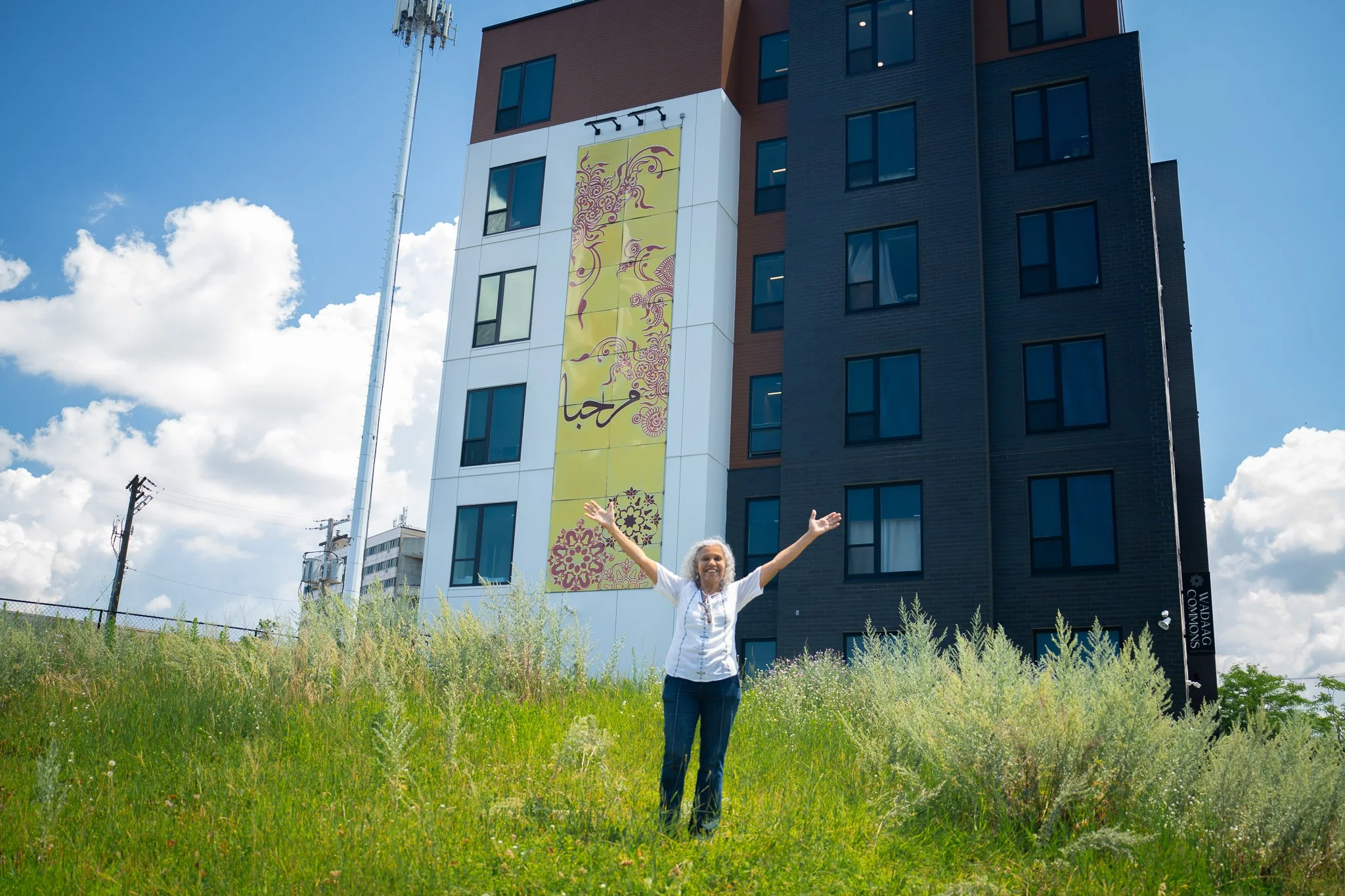
“First of all, it’s a Somali community, and second, there is a woman heading the project,” Hend explains. “Henna was the best representative in my mind to embody this.” Hend’s artwork often draws on elements inspired by art forms traditionally practiced by women.
“With my background, I celebrate the visual language of Arab and Islamic people,” she explains. “I like geometric design and henna designs, but there are also a lot of women’s traditions in Saudi Arabia that are not as known.”
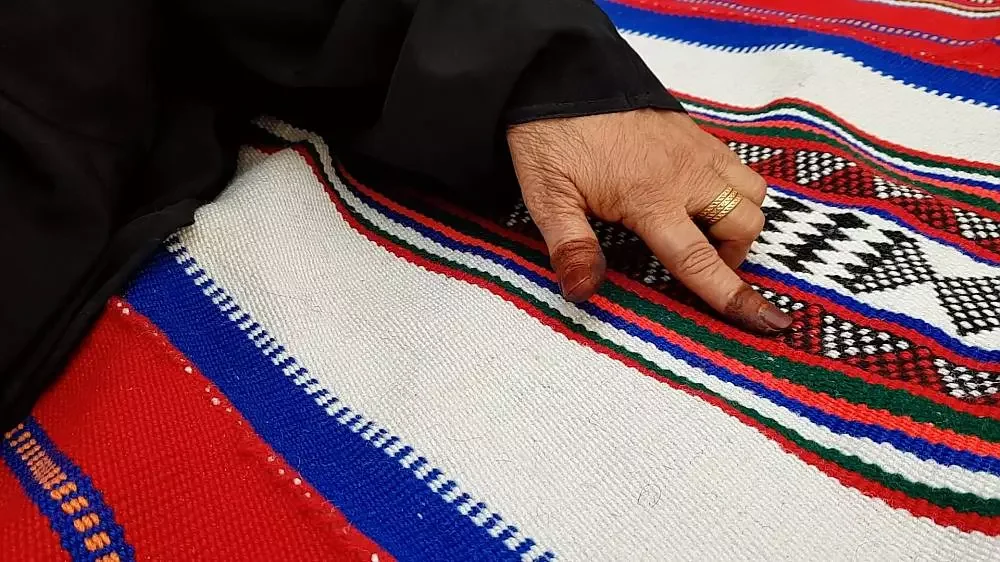
One such practice, called Qutt, is traditionally practiced in southern Saudi Arabia and features bold, geometric artwork hand-painted by women in and around entrances to their homes. Another that inspires Hend is Sadu, a style of weaving done by Bedouin women with a particular language of design and color. These art styles are well known in their home communities, but are rarely considered to be “serious” artwork in the West.
“I borrow all these traditions of Arab women and put them into my work. Because of my background, I witnessed firsthand how women were second degree citizens. I still have this heritage, this baggage inside of me around feeling inferior,” says Hend, “so my art always wants to prove to myself that I am a human, a full human being.”
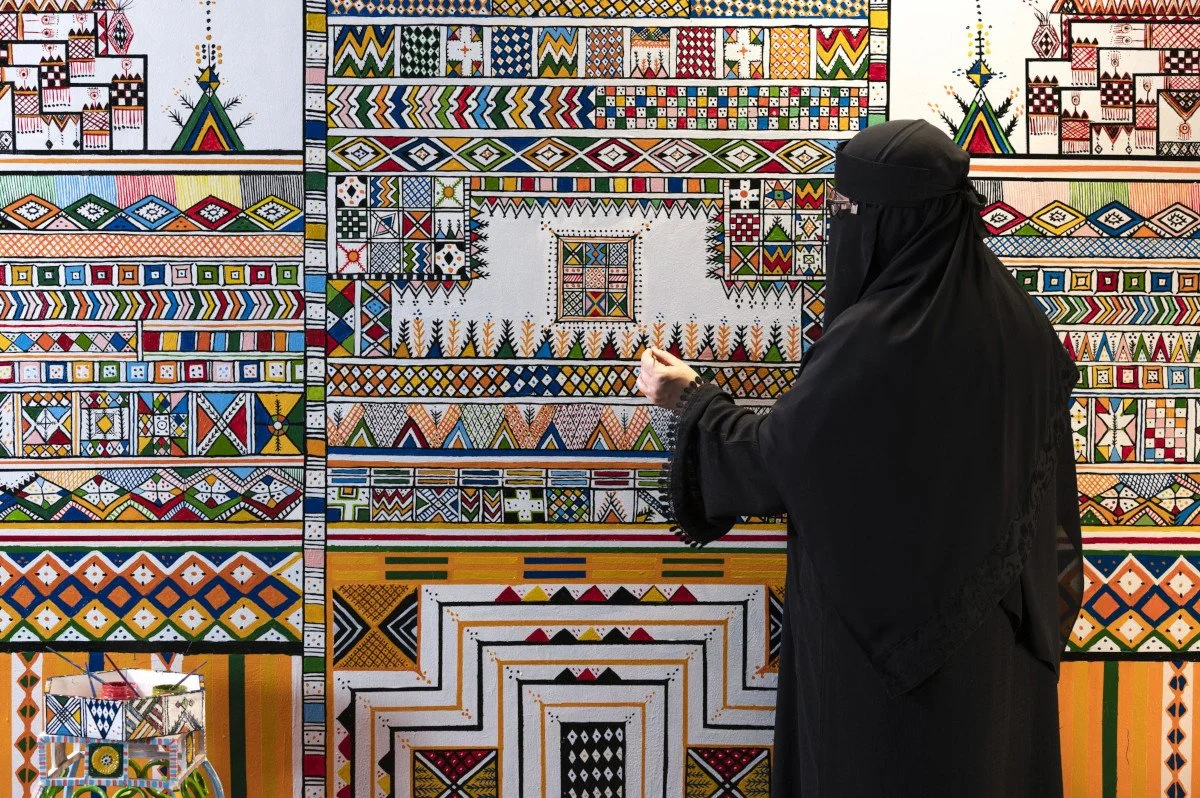
Left: Woman painting a wall using the Asiri art of Al-Qatt. © Ali Lajami, 2024.
Right: A woman’s hand with henna on the fingertips points at details in an Al Sadu weaving. © F. Al-Sabah, 2019.
Hend’s artistic career has been a lifelong endeavour, but it wasn’t always her main focus. She studied medicine in Saudi Arabia and had a successful career as a cardiologist before moving to the United States. Here, Hend planned to start a new life beginning with a fellowship at the Mayo Clinic, but quickly received news that changed the course of her life: A cancer diagnosis.
“It was a shock for me, because the reason why I came here was not really the fellowship,” Hend explains, “it was to get out of Saudi Arabia and to start a new life.” This diagnosis was an obstacle right at the start of her path - but Hend kept moving forward. She sought treatment and the disease went into remission, leaving Hend with a new perspective towards her life.
“Every minute counts now,” she says. “I felt the preciousness of time, and so I wanted to do what I like to do.”
Enameling was a brand new process for her, but she took to it quickly with her experience in printmaking. With help from CAFAC’s fabrication team, including Heather Lasair, Tabitha Nelson, and Jordan Hamilton, she learned to prep panels, mix colors, and use stencils to spray and fire her designs on each of the 20 panels that make up the mural.
“I kind of stepped back, because I’ve never done this before. It was an exciting process, and I liked working at [CAFAC] a lot! I liked watching other people do other crafts, and I want to try everything there,” Hend smiles.
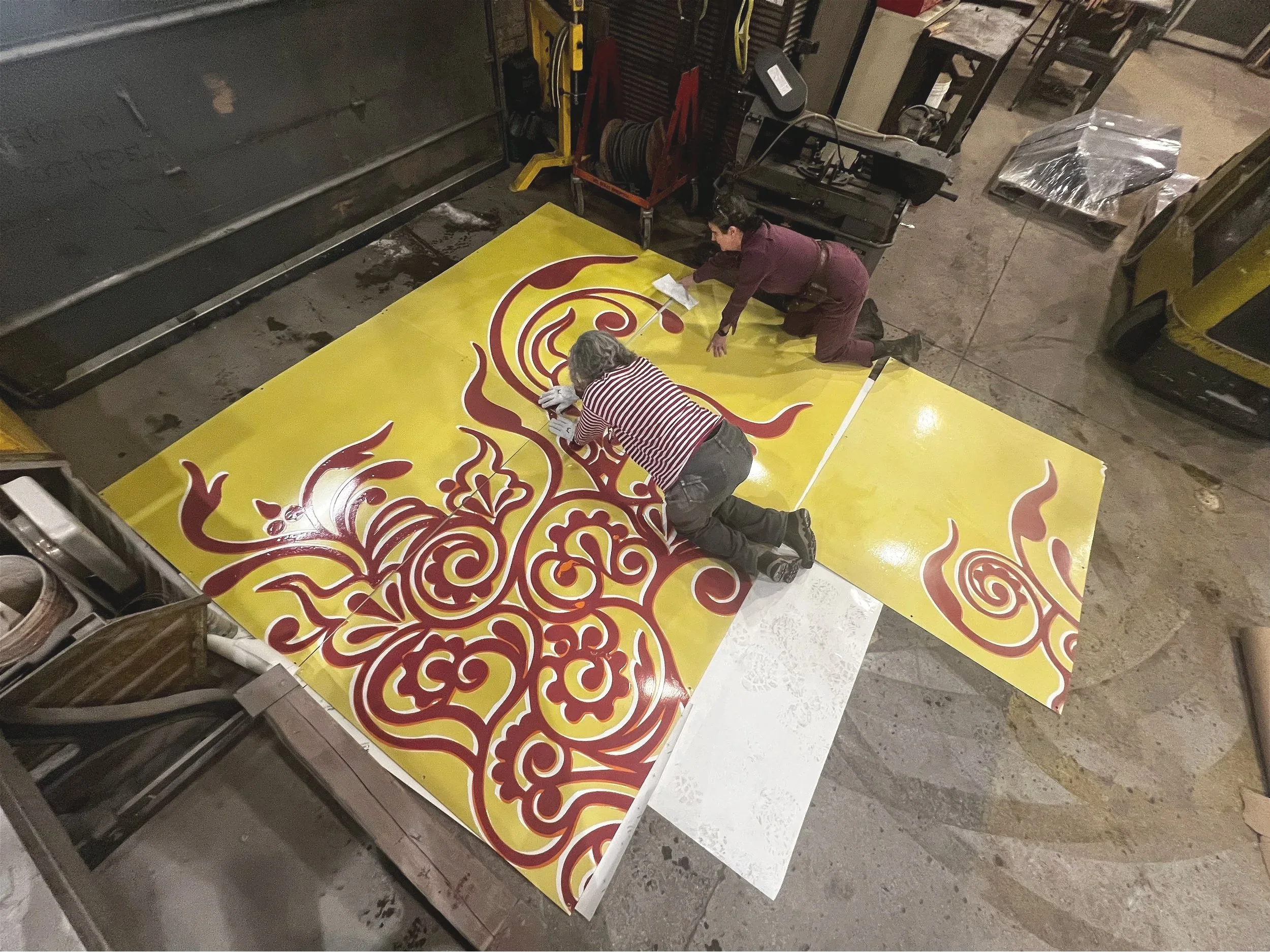
Hend Al-Mansour and Heather Lasair lay out and inspect in-progress pieces of the mural.
HIBAAQ IBRAHIM
Hibaaq’s pieces - a decorative utility surround, pergola panels, and ornamental archway elements - feature plant-inspired designs.
These sculptures were an evolution of her work in large-scale murals, an art form she began practicing in 2020 after George Floyd’s murder and subsequent civil unrest.
“So much was going on, so many community art events to process what was happening and feel less hopeless,” she explains. “I had just learned about murals and thought that was one way I could contribute. I loved it so much I started doing more murals on my own, and with the youth in the 4H club I co-ran.” The connection and joy Hibaaq found through this form of public artwork hooked her - since then, she’s created dozens of commercial murals for private developments and city projects.
Designing for the Wadaag Commons project proved a challenge. Hibaaq designs her murals for head-on viewing; 3D sculpture, on the other hand, could be seen from any angle.
“I needed some help from Heather to see sculpture in my head.” she says. “It may have been my design, but there is no way I could have done it without CAFAC, OCW, and some friends who understood how to think in 3D.”
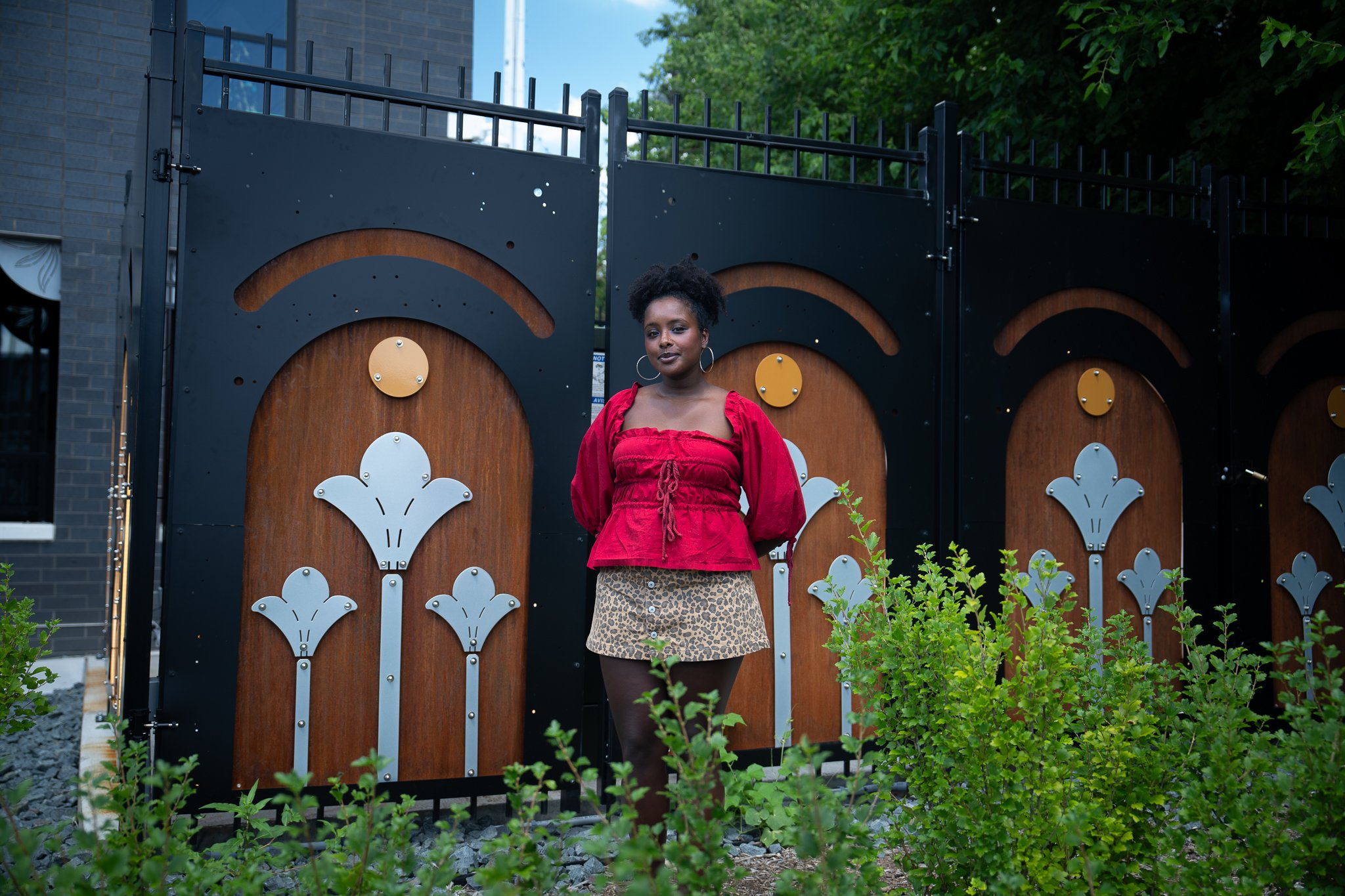
Hibaaq Ibrahim stands in front of one of her pieces, which surrounds utility connections near the building. © Brian Few Jr., 2026.
For Hibaaq, sharing joy is one of her main inspirations for creating artwork.
“Joy is so important to me and one of the major reasons I started sharing my art publicly in the first place,” she says. “It seems so simple, but it’s everything. People who walk by my public art often tell me it’s a bright spot in their day - that makes me so happy I could cry!”
Along with creating inspiring pieces for public spaces, Hibaaq is interested in creating miniature wooden murals for homes, exploring more 3D artwork with furniture making, and finding ways to pass on what she’s learned to young creatives.
“The path to full time art is difficult, and there isn’t a clear cut path to that in terms of schooling,” says Hibaaq. “I’d love to see more of them finding success and sustainability.”
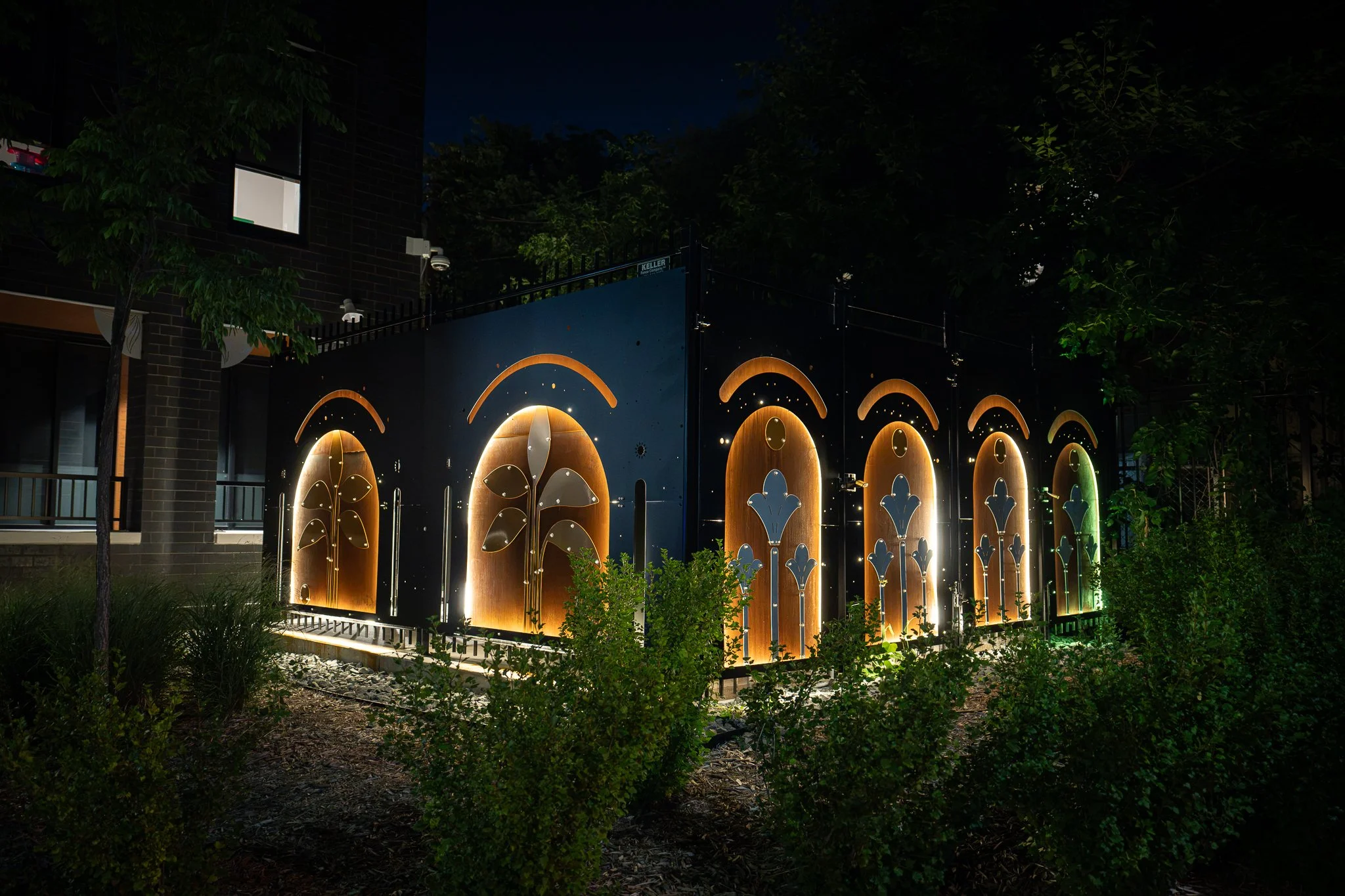
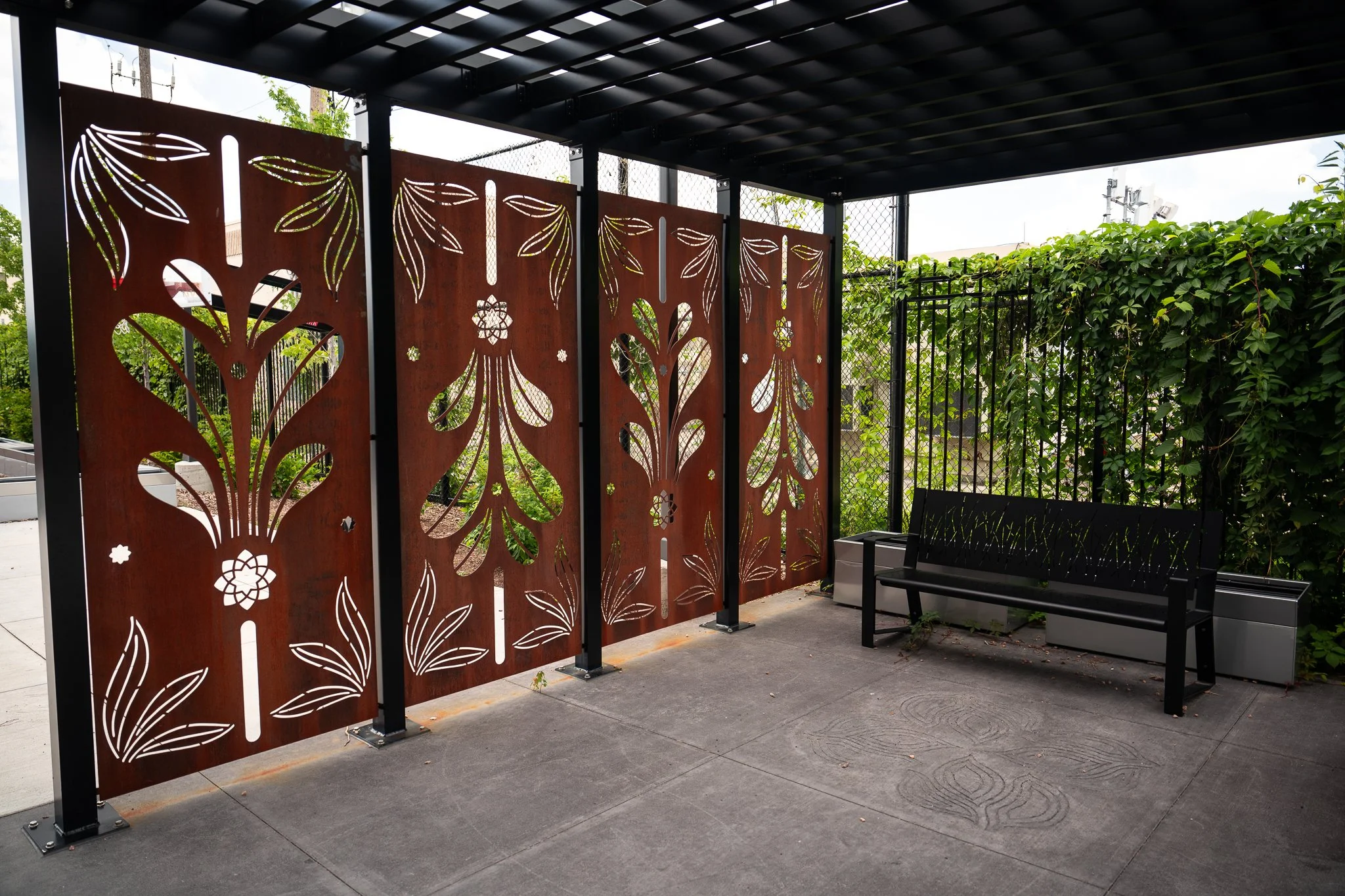
Left: Utility surround, illuminated at night. Right: Four panels that make up part of the outdoor pergola installation. © Brian Few Jr., 2026.
YASMIN YASSIN
Yasmin Yassin’s pieces, on the other hand, live both inside and outside of Wadaag Commons. Along with drawing on traditional Islamic motifs, she centered warmth, community, and belonging in her designs.
“As somebody who grew up in public housing, it was a very, very bland environment,” Yasmin explains. “A lot of browns, a lot of concrete, and not much green space.” To her, her artwork could be a source of grounding for the building’s youngest residents throughout their formative years.
“[These pieces] are the first thing you see when you’re coming in and out of the building, or when the elevators open up,” she explains. “The idea is that as you’re going through major life events, there’s that stability in terms of the environment.”
Her designs drew on her personal experiences as well as her past work in a specific process: Cyanotype. For Yasmin, the muted blues of cyanotype prints remind her of the warmth of home.
“My grandma always had a blue carpet with geometric patterns on it that felt very comforting and homey. Over the years it became very muted in color, from how many times we sat on in or rolled on it or stepped on it,” she recalls. “So I created these cyanotype carpets - the idea being a carpet that you would see in a house like my grandma’s house.”
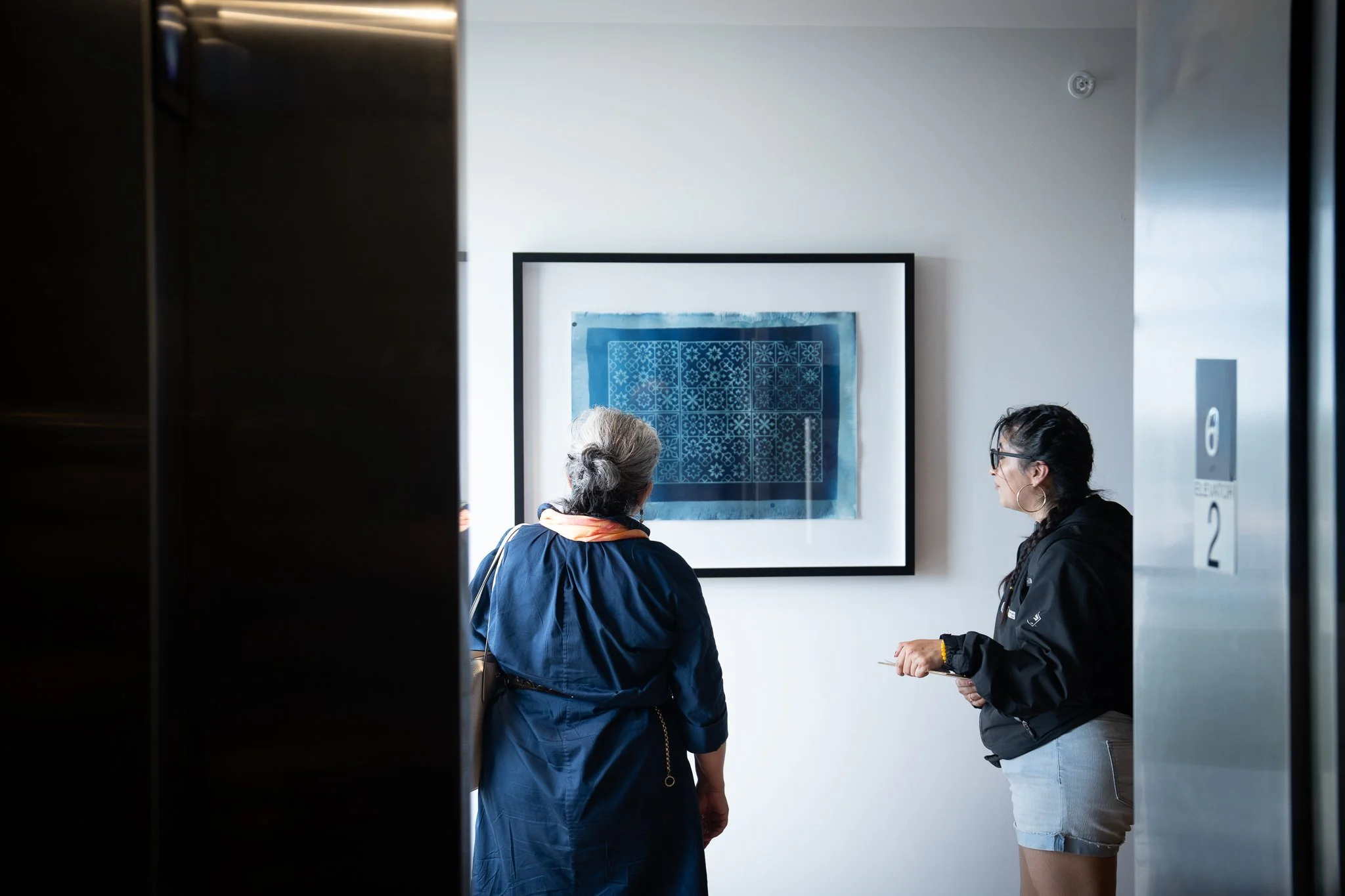
Two visitors admire one of Yasmin Yassin’s cyanotype prints inside the Wadaag Commons building. © Brian Few Jr., 2026.
Yasmin’s large, outdoor piece shares similar geometric designs - and the color blue - with these indoor prints.
“I did want to have that ‘cross talk’ with the pieces on the outside,” she explains. “I did similar conceptual work in terms of geometric inspiration as well as to recreate the idea of home.”
Her piece, which she calls “Three Sisters” in a nod to her own family, features three stacked hexagons cut out of weathering steel, fitted with blue glass panels that illuminate at night. Her first concept for this sculpture was modeled off of incense burners that many families use at home, but after an iterative design process, Yasmin settled on a more abstract piece.
“The idea of light shining through these patterns was the concept throughout,” she says. “This piece is an homage to the concept of community and interconnectedness,” that the development aims to create for its residents. “It would light up your way as you entered in the evenings or left early in the mornings, and would play with that shade of blue, the warmth of the carpet that I remembered growing up.”
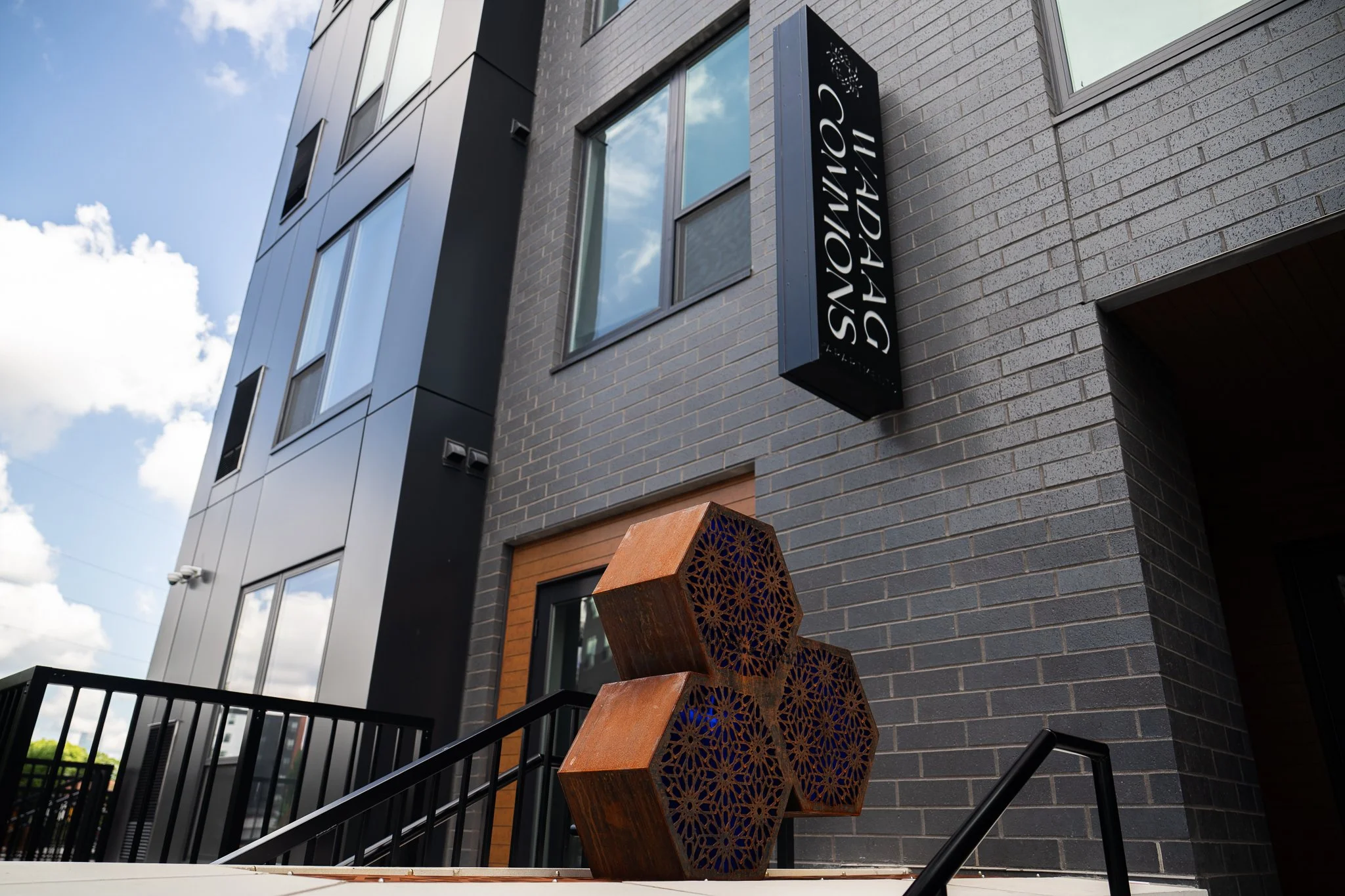
The outdoor “Three Sisters” piece designed by Yasmin Yassin, just below the Wadaag Commons entrance sign. © Brian Few Jr., 2026.
The Wadaag Commons project was Yasmin’s first foray into this type of public art, and her first time working with metal. Her work draws on a range of techniques and mediums, including photography, print, paper, and film, but has generally existed in the digital and 2D realms. Like for Hibaaq, designing for 3D meant shifting her mindset - but through the iterative design process practiced at CAFAC, she had plenty of support.
Once a general concept was settled upon - in this case, three stacked hexagonal prisms with geometric designs on their faces - Yasmin engaged in the CAFAC tradition of creating a miniature maquette of her piece to better understand how her work would look in 3D space and work out any kinks. Once the design was finalized, CAFAC’s public art fabricators took over to create and assemble each element. Yasmin stayed involved throughout the process and ended up enjoying the metalworking space quite a bit.
“As things were being made, I would come in as much as I could to watch and learn and help as well. It was very collaborative - very fun actually - and it was great to physically be there during fabrication. I was able to bring my daughter in at times too, to show her [the piece] as it was being built,” says Yasmin.
“It’s so exciting to see art live among the built environment of people,” says Yasmin. “Especially as somebody who has worked with 2D a lot, film and photo, I live in the digital realm a lot.”
“Because it’s a public art piece, I feel okay with people interacting with it however they want to. It has intimate meaning for me,” she says, referring to the childhood memories and siblings that “Three Sisters” invokes, “but I hope it provides meaning to people in other ways too.”
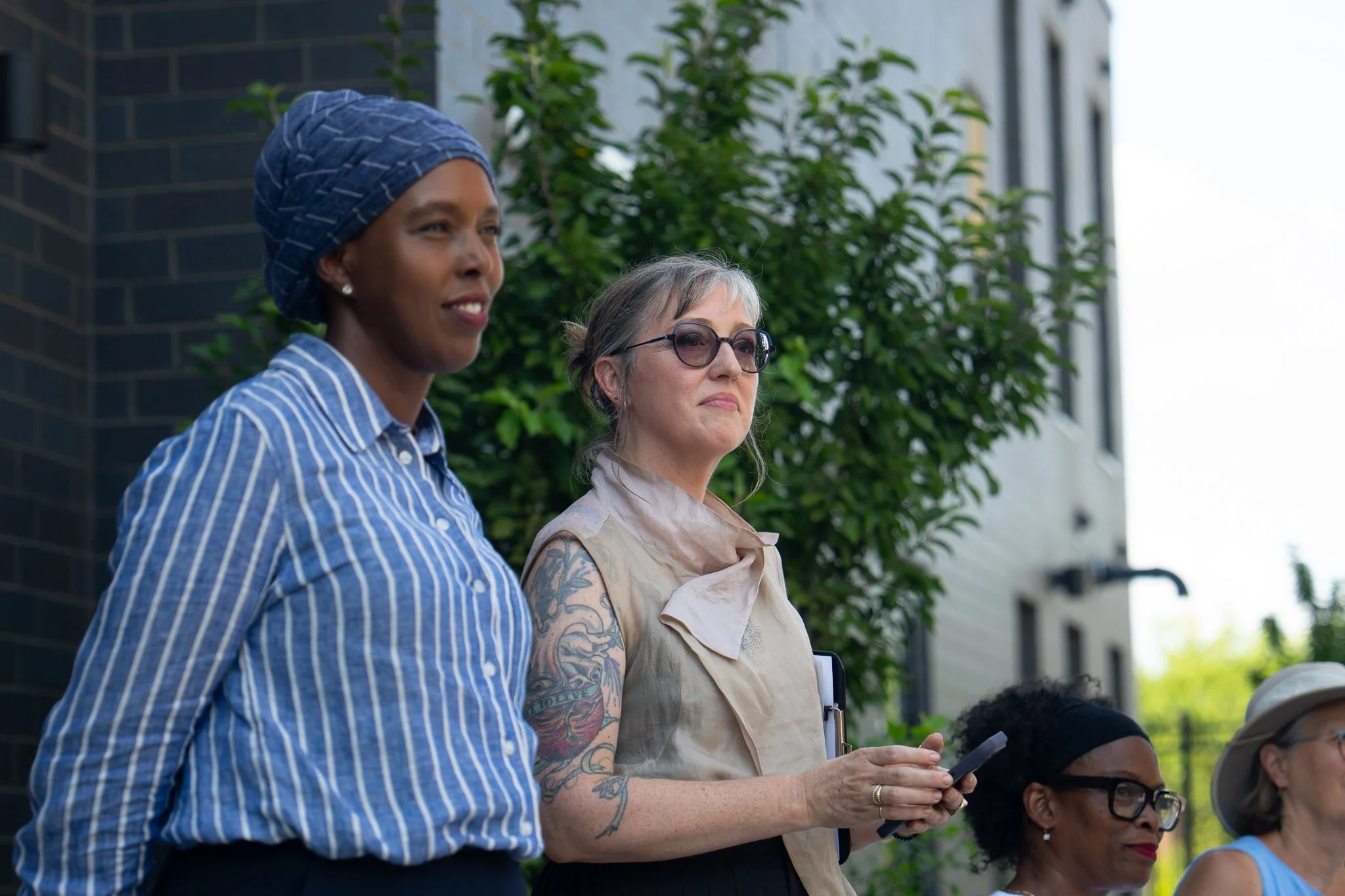
Nawal Noor (Noor Companies) and Shannon Brunette (Office of Cultural Work), pictured at the Wadaag Commons dedication event on July 11, 2026. © Brian Few Jr., 2026.